


Rooting for Pedagogy Science -- Orientation Day I

Updated: Sep 13, 2021
Rooting for Pedagogy Science - Juurtuminen pedagogiikkaan 25.08.2021
Background
I have been associated with the educational system and professional work life for nearly a decade now. I completed a Masters and PhD in Finland and worked for various academic and non-educational Finnish organisations in different positions. Everywhere I went I heard people talking about Finnish pedagogy and using those pedagogical methods; frankly speaking, this term and these talks are always new for me. Firstly, these were frustrating but later I became interested in these talks and methods. Finally, I decided to apply for pedagogical studies, which was comprised of 60 credits. I have been admitted to the 2021-22 pedagogical program at University of Applied Sciences.

Opening

The opening day started with around 20 people, including three teachers. The introduction started in the opening session, we had to briefly introduce ourselves and quickly had to answer how we were feeling today. This was a tough question for everyone to answer because, no one knew how everyone was feeling at a general level or if we knew we did not have words to tell or maybe everyone was nervous. If I remember right, I said that I was feeling kind of OK and talked about the weather. This session was approximately 45 minutes, and was a great way to get to know the group; it was so diverse and with very different educational and experience backgrounds.

Picture Credit: Opening day presentation by OAMK

Interactive Session
Discussion continued after the coffee break, generally covering various topics, including the education system in Finland, professional teacher education, vocational pedagogy, and work-life related learning. The short profile and description of the work and duties of the teacher involved in this diploma were briefly explained. Teachers also described the competence-based education system in Finland at a general level. Additional official information regarding the study affairs, student logins and meal card distribution was also discussed. So, in conclusion, as an attendee, I mainly understood all official matters and how this program might proceed. Many participants, including me, asked many questions, but the teachers explained everything politely, improving my understanding of the whole concept. These short few hours also provided a window into how the online hybrid system has been working and what it looks like to work in a diverse group of people. Teachers did a brilliant job of making us aware of the important matters.
Understanding Pedagogy Concept

The teacher described pedagogy as the centre or overlapping point of vocational pedagogy, didactics and working life learning. To improve understanding, the teacher used the Padlet to collect class members' opinions about these thoughts (Padlet picture 1). In few minutes, everyone commented about their understanding of vocational pedagogy, working life pedagogy, vocational pedagogy, didactics, and pedagogy. After completing the thought process in writing form in an online Padlet, everyone re-joined the 'general teams’ group' for a discussion. In the next few minutes, the teachers discussed all the comments written in the Padlet. Some agreed upon the key points, but some were very relative points of view. The main take-home point that I got was the message, "learning through doing". So, in vocational pedagogy, which is the main scope of this diploma, our focus should be on doing things practically. We cannot discard the theory part of lectures, but this is only a portion of the overall learning and teaching process. It is not recommended to do everything through simple and monotonous lecturing only.

Competency-based Curriculum
The biggest challenge was to understand a competency-based curriculum. What I perceived this as, is as followed,: "Competence comprises various levels, and everyone does not have the same level of competence in certain tasks. Different people can have different levels even in the same class, such as beginner, competent, proficient, or expert. Once we know our goal, the next step is defining competence goals, which means what level of competence we want to achieve. Later we move towards assessment and demonstration of competence. What are the criteria and standards we must use to access competence, and how do we demonstrate after achieving a certain level of competence.”


Comptency can be demonstrated by adopting various methods such as certifications, reports, diplomas, videos, interviews, teaching, workshops, RDI activities, evaluating the teaching materials, articles, and publications. This tool can also provide the primary use of technology and methods for your future lectures to your students. But the essential way of competence demonstration, instructor mentioned for this professional teacher training, is 'blog reflection' of all main occurrences. It can be a good tool for reflection as it is nearly impossible to copy and paste anyone else thoughts and perceptions about the specific day of learning. Therefore, I think it is a win-win situation.
When we say using the blog reflection method to demonstrate competence, what does the reflection mean? I think anyone reading this blog and has reached this line has got my way of reflecting on day one of the Professional Teacher Pedagogy at the Oulu University of Applied Sciences. Therefore, I am mirroring my learning and demonstrating it in the form of this blog. After reading this blog, readers will decide my level of competence based on what I described as vocational pedagogy and all related things discussed on the first three contact days.
Group Exercise
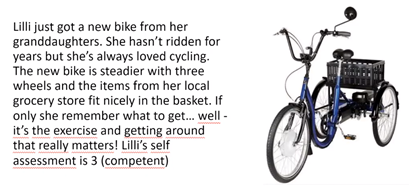
Teachers had chosen one bicycle exercise to make us understand competence and how to demonstrate competence. For this, different scenarios were being provided in groups of four people. We were a group of three people and went in our group meeting window. The main focus was to recognise and display bicycle riding competence and later assess the level of competency. Three of us investigated our case, which is as follows:
The teacher has provided a list of different words to describe this case.
These verbs were developed based on Bloom's Taxonomy (Blooms Higher Level Verbs | Curriculum | Mesa Community College (Mesacc College, 2021)
We discussed in the group and used the set of verbs to describe Lilli's demonstration of competence and how her journey about learning to ride a tricycle with very little experience of riding a bicycle. It is also good to fit competence in sort of skills acquisition model such as Five-Stage Model of Adult Skill Acquisition by Stuart E. Dreyfus in 2004. This model has divided skills acquisition into three stages.
Stage1: Novice
Stage 2: Advanced Beginner
Stage 3: Competence
Stage 4: Proficiency
Stage 5: Expertise
The last activity of the day was to ensure that every participant reflected on the day in the form of Expectations vs Realities for the teachers. Janne used a Padlet, and everyone wrote their thoughts. The comments were as follows Padelt 2:

As you can see in the picture, there were six scenarios,. All participants have an understanding of the expectation in various roles. In the following discussion section, all participants agreed upon many things, while some of the items have differences of opinion. I think this is also related to the level of competence, demonstration, and reflection in comments. This was the conclusion of day 1.
References:
Dreyfus, S.E., 2004. The five-stage model of adult skill acquisition. Bulletin of science, technology & society, 24(3), pp.177-181.
College, M., 2021. Blooms Higher Level Verbs | Curriculum | Mesa Community College. [online] Mesacc.edu. Available at: <https://www.mesacc.edu/employees/course-management/curriculum/resources/blooms-higher-level-verbs> [Accessed 13 September 2021].
Oamk.fi. 2021. Professional Teacher Education :: Oulun ammattikorkeakoulu :: Opinto-opas. [online] Available at: <https://www.oamk.fi/opinto-opas/en/school-professional-teacher-education/professional-teacher-education> [Accessed 13 September 2021].
Aaltodoc.aalto.fi. 2021. [online] Available at: <https://aaltodoc.aalto.fi/bitstream/handle/123456789/4755/isbn9789526030357.pdf?sequence=1&isAllowed=y> [Accessed 13 September 2021].
About Author

Afnan is an RDI Specialist at the LAB University of Applied Sciences. His research areas include product and service development, innovations, knowledge creation, brain drain in Finland. He is also a work-life coach and multicultural trainer in Arffman (Barona Oy), Finland. Additionally, he has worked in five different countries and completed multiple university degrees in Finland and abroad. He has also worked as a researcher in Finland and Sweden. His blog series named Rooting for Pedagogy Science is his personal journey to learn pedagogy in Finnish perceptive.
Connect with Afnan on LinkedIn



Comments