


Assessment, Evaluation and Feedback 13.10. 2021


Today’s Competence Goals
You understand the meaning and goals of assessment in the learning process.
You understand the amendments, guidelines and practices that regulate and govern assessment in vocational and higher education.
The day started with a thirty-minute discussion about the competence one and competence two courses. The discussion centered around how these courses differ from each other and when the competence two course training can be started. Many participants had various inquiries regarding the competence two courses because of their personal and professional situations. The instructors did their best to answer the questions. I also asked a few questions regarding the teacher training at work. It was agreed that everyone has to make their teaching plan for the competence two courses after discussion with their tutor.
After the initial discussion, all groups went to their respective teaching classes. Each class had four consecutive lectures. The following are the names of the groups and their individual tasks:
Groups and their Respective Tasks
Amazing Group: What are the goals and intended outcomes of assessment and feedback in vocational education/higher education?
Group 5: What is the difference between assessment of competence and assessment of the learning process? What kind of feedback/assessment methods can be used?
Group 1: How do the assessment methods reflect the view of learning and the learning theory behind them? Use at least one theory/view of learning as an example in your teaching task!
Group 2: What are the most common assessment methods, how do they work and how do they differ from each other?
Group 3: Special task shared by tutors.
I went to ROOM 1, and the first lecture there was delivered by Ha. She systematically covered the Group 2 topic.

She divided the lesson into four main parts: learning outcomes, participants' experiences, essential information gathered, and further discussion. The lecture was interactive, and many videos were used. So, the participants watched the video, and afterwards, there was a time for questions and discussion.
Ha noted down all the key points in the discussion, then related them to the theoretical elements. The following is a selection of some of the interesting videos that have been shared.
There was some lecturing about why assessment is needed and what the typical assessment methods are. Ha connected all the theoretical elements with practical elements, such as the experiences of our own pedagogy studies.
Three assessment methods were mainly covered in the lecture: diagnostic, formative and summative assessment. The methods were first clearly defined using examples, then their similarities and differences were highlighted. Overall, the lecture was interactive on many levels; while the presentation was not particularly visual in nature, the involvement of video content did add a visual element.


The second presentation I will describe is that of the Amazing Group. While we divided the group work among our group in the previous lecture, this time it was Teija's turn to take the lead. The first draft was made ready, and everyone commented and added content. Our presentation focus was mainly on the goals and intended outcomes of the assessment and feedback. The lecture started, and I clearly described the objectives of my lecture. I focused on five key areas of assessment and feedback—summative and formative assessment, the purpose of student assessment, the feedback itself, and the conclusion.
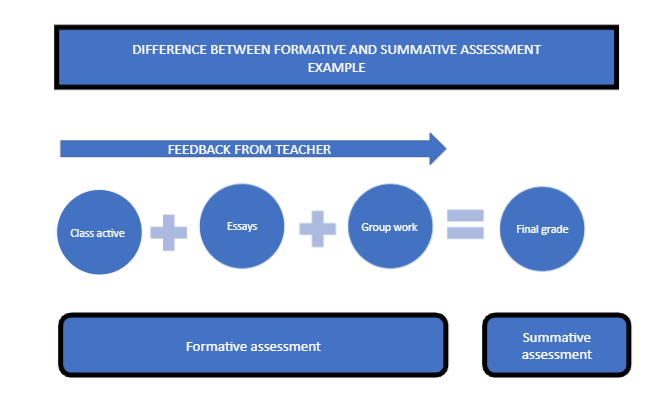
I covered the differences between assessment and feedback lists, using various videos to give a visual representation of the concepts. Following this, I moved on to the purposes of assessment, and we explored this in a group discussion.

In the last part, I conducted a role play, playing the part of the father of a young student who has just started their studies at the University of Applied Sciences and cannot understand the Finnish assessment system. Everyone participated in it and tried to explain the feedback and assessment system at Finland's University of Applied Sciences.
After the short break, Eirini from Easy Group gave her lecture about learning assessment methods.

She described four distinct learning theories: behaviourist, cognitive, constructivist, and social-cultural. She did a quiz on Kahoot.it about learning theories. Initially, there were problems in tests as her laptop was not working well, but eventually she overcame these issues. There were 15-minute discussion sessions in which various cases were provided, and for each case, Eirini asked us which theory had been used. There were some right and some wrong answers. After this, the solutions were discussed, and everyone gave opinions. It was also noticed that in many cases, some theories overlapped with each other. There was also a feedback form so that participants could provide their feedback about the lesson.

Jing gave the last presentation about competence assessment and learning process assessment. She used the example of riding a bike and started the session with a 5-minute discussion.
The context of the case was as follows

She talked about assessment in terms of qualitative and quantitative means. Later on, she connected principles of evaluation with validity, flexibility, reliability and fairness. Like all other groups, diagnostic, formative and summative assessments are associated with competence assessment. Jing also discussed direct and indirect assessment, the 360-degree assessment feedback process, continuous assessment, and the role of examination in assessment. At the end, feedback about the lecture was collected.

When the four lectures ended, everyone went back to the main room, and the Group Three participants commented about classes. It was emphasized that time management and the endings of lectures should be well planned. Each person in Group Three shared their thoughts.
Finally, Afrooz from Group Three talked about anti-bullying—since October is a month-long anti-bullying event, aimed at preventing childhood bullying and promoting kindness and inclusion. She reminded everyone of their duties as teachers to prevent bullying at school and in the surrounding environment. The session was ended with some concluding remarks by the instructors.
References
Visualcapitalist.com. 2021. [online] Available at: <https://www.visualcapitalist.com/wp-content/uploads/2020/02/50-cognitive-biases-2.png> [Accessed 11 October 2021].
Aaltodoc.aalto.fi. 2021. [online] Available at: <https://aaltodoc.aalto.fi/bitstream/handle/123456789/4755/isbn9789526030357.pdf?sequence=1&isAllowed=y> [Accessed 25 September 2021].
Biggs, J. (1999) Teaching for Quality Learning at University (pp. 165-203). Buckingham, UK: SRHE and Open University Press. https://engineering.purdue.edu/ChE/aboutus/publications/teaching_eng/chapter14.pdf
Teaching Engineering - Wankat & Oreovicz Learning Theories Chapter 15
Teaching Engineering - Wankat & Oreovicz Models of cognitive development: Piaget and Perry 1994
Teaching and Learning in Higher Education: New Trends and Innovations. University of Aveiro, 13-17. 2003.
The Education system in Finland in 2011 – Materials provided by OAMK instructors
Vocational Skills Demonstrations in Finland – Materials provided by OAMK instructors
Dreyfus, S.E., 2004. The five-stage model of adult skill acquisition. Bulletin of science, technology & society, 24(3), pp.177-181.
College, M., 2021. Blooms Higher Level Verbs | Curriculum | Mesa Community College. [online] Mesacc.edu. Available at: <https://www.mesacc.edu/employees/course-management/curriculum/resources/blooms-higher-level-verbs> [Accessed 23 September 2021].
Oamk.fi. 2021. Professional Teacher Education :: Oulun ammattikorkeakoulu :: Opinto-opas. [online] Available at: <https://www.oamk.fi/opinto-opas/en/school-professional-teacher-education/professional-teacher-education> [Accessed 23 September 2021]
James, M. (2006). Assessment, teaching and theories of learning. In Assessment and Learning (pp. 47-60). London: Sage.
https://onlinelearninginsights.wordpress.com/2013/05/15/how-couse-design-puts-the-focus-on-learning-not-teaching/
https://www.researchgate.net/publication/271964452_Assessment_Teaching_and_Theories_of_Learning
https://lidtfoundations.pressbooks.com/chapter/behaviorism-cognitivism-constructivism/
https://gsi.berkeley.edu/gsi-guide-contents/learning-theory-research/learning-overview/
About Author

Afnan is an RDI Specialist at the LAB University of Applied Sciences. His research areas include product and service development, innovations, knowledge creation, brain drain in Finland. He is also a work-life coach and multicultural trainer in Arffman (Barona Oy), Finland. Additionally, he has worked in five different countries and completed multiple university degrees in Finland and abroad. He has also worked as a researcher in Finland and Sweden. His blog series named Rooting for Pedagogy Science is his personal journey to learn pedagogy in Finnish perceptive.
Connect with Afnan on LinkedIn



Comments